
Loading...
Loading...
Consejería de Transición Ecológica y Energía · Gobierno de Canarias
Where the islands stand on renewables, and where they must be by 2030


The Canary Islands did not come to the round table as an outside adviser. They came with the numbers of a territory that is itself behind on renewables and is spending heavily to catch up — which is exactly what makes the exchange with Mauritania symmetrical.
The presentation sets out the global context, the current Canarian mix, the 2030 targets the islands are bound to, the installed wind and solar capacity, the explosive growth of self-consumption, the state of distributed storage, and the funding programmes behind it all.
Read alongside the Mauritanian portfolio presented the same morning, it defines the shared agenda: isolated systems, high renewable penetration targets, storage as the binding constraint, and a shortage of qualified installers and engineers on both shores.
Climate change is visible and tangible at every level: high average temperatures through the year, and increasingly extreme weather episodes — calima dust events, floods, droughts, rising sea levels.
Worldwide, the energy sector — including electricity generation — is responsible for 79% of the European Union’s greenhouse gas emissions. Energy production and transformation, together with its consumption in industry, homes and transport, are the main contributors.
Transition to renewables — increasing the share of clean sources in the energy mix.
Energy efficiency — implementing savings measures and efficient energy use.
Electrification of the economy — replacing fossil fuels with electricity from clean sources across sectors.
The targets the islands are working to, as set out in the presentation.
Against 5% today — the steepest of the targets.
The share foreseen at national level for electricity generation.
The minimum level of renewable penetration for the archipelago by 2030, against the 81% foreseen nationally.
Reduce the contribution of fossil-fuel plants to the electricity mix by at least 50% by 2030 against 2019. Since fossil combustion was 84% of the Canarian mix in 2019, that share should be at most 42% in 2030.
An archipelago with no interconnection to the mainland and a country building its grid from Nouadhibou to Néma run into the same three constraints: firm capacity, storage, and people qualified to build and operate it all.
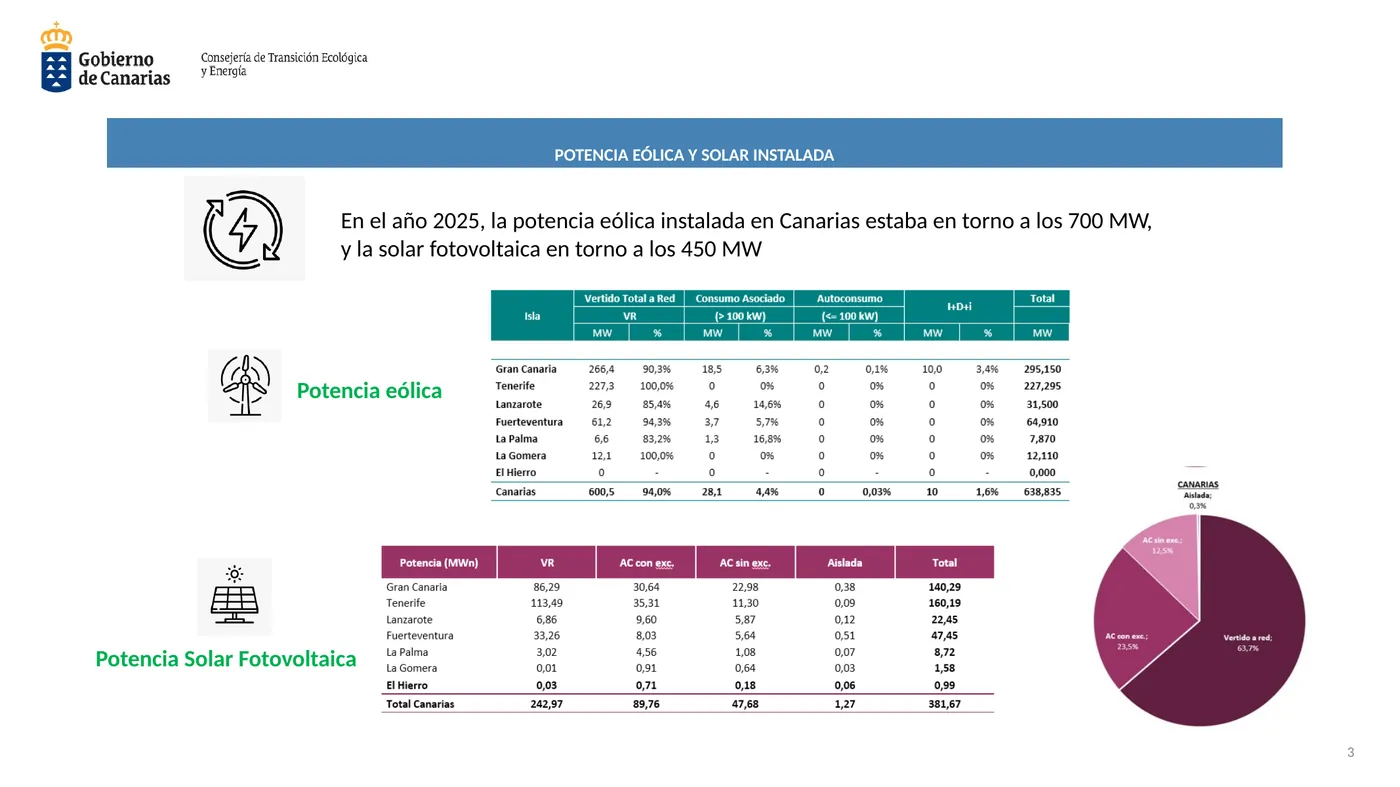
In 2025, installed wind capacity in the Canary Islands stood at around 700 MW and solar photovoltaic at around 450 MW.
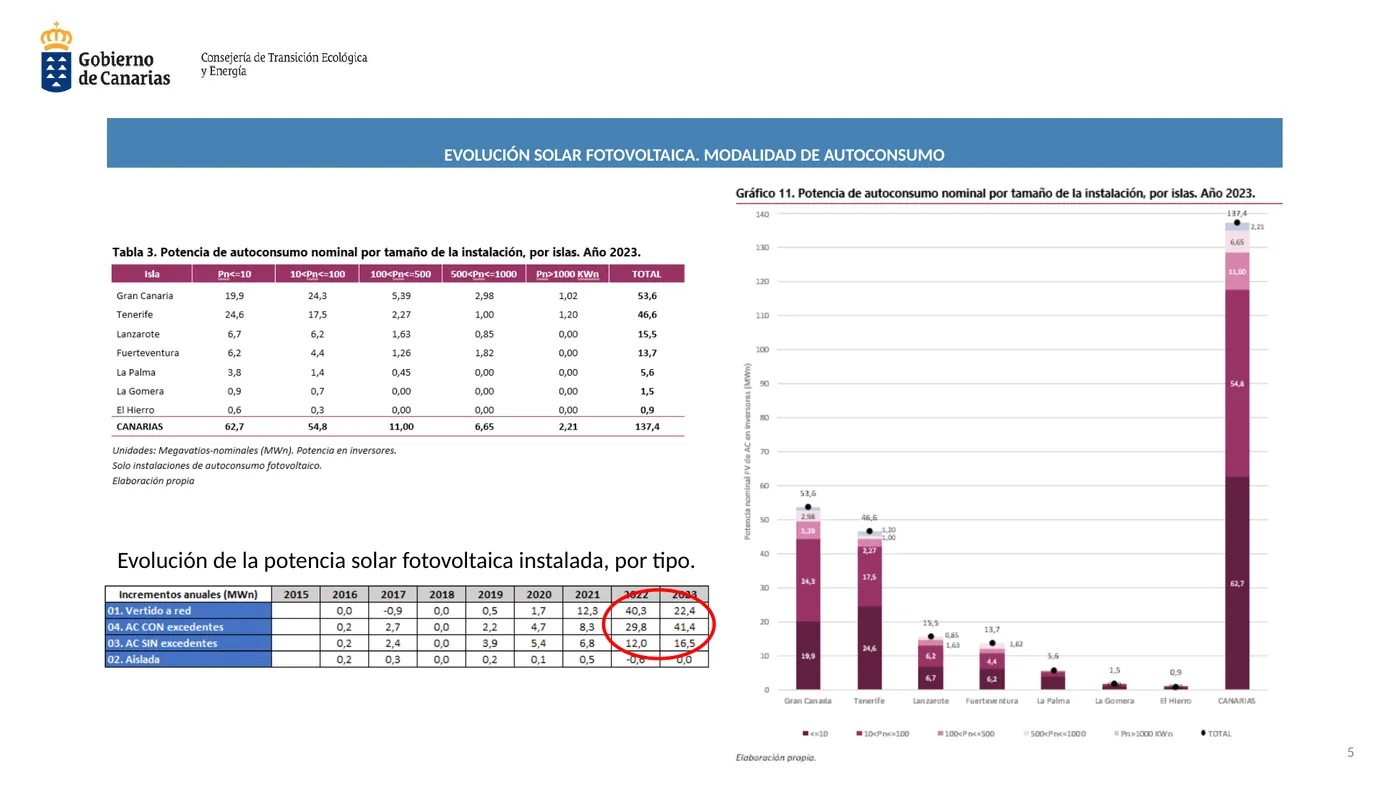
Self-consumption is where Canarian demand has moved fastest — and where the installer, equipment and training markets have grown with it.
63 guarantees confirmed in 2024 for stand-alone batteries, and 27 confirmations so far in 2025 — guarantees requested and not returned.
5 applications for administrative authorisation in process — 1 in Tenerife and 4 in Gran Canaria.
1 additional access discrepancy recorded in Tenerife.
Two programmes carry the bulk of the public effort, with a combined ambition of some 158 MW of additional renewable capacity and a large storage build-out.
Renewable objective: an additional 120 MW of renewable production capacity in the islands by June 2026.
Priority P2A, green transition. Renewable objective: an additional 78 MW of renewable production capacity by the end of the programming period.
The full deck contains the complete series of charts on the Canarian mix, installed capacity, self-consumption growth, distributed storage and the funding programmes behind the 2030 targets.